Here’s what’s actually happening on your services page
You’ve got a package or programme you’re proud of. Maybe it’s a set number of energy healing sessions, a course, or your signature work, the approach you’re known for and have spent years refining. You know what it does for people. You’ve seen it happen.
But right now, that programme lives as a line on your services page (the page on your website that lists what you offer and what it costs), if you have a services page at all. A title. A price. Maybe a short paragraph.
And here’s the problem with that. When someone lands on your services page and sees a price before she understands what the programme would change for her, she decides on the number. Not on the value. Not on whether it’s right for her. On the number.
The ones who would have said yes if they’d understood… they don’t say no. They drift away. You never know they were there.
The other thing that happens: people book a discovery call (a free chat before they commit, some call it an initial consultation) to find out more. So you do all the explaining live. You make the case for why it’s worth it, field the questions, watch their face and try to work out whether they’re convinced. And if selling on calls makes you want to cancel your calendar and become a librarian, you’re not alone.
Your services page is a menu. A menu helps someone choose between options. It can’t make the case for any one of them.
Sound familiar?
You’ve probably already tried to solve this
Maybe you’ve had a go at writing a proper page for your programme yourself. You sat down, opened a document, and stared at it. Or you wrote something and it came out sounding like a brochure. Accurate, but flat. Nothing like the way you’d explain it to someone sitting across from you.
Maybe you found a template, a fill-in-the-blanks page someone else designed. Templates are built around someone else’s offer, someone else’s voice, someone else’s client. You filled in the blanks and it still didn’t sound like you.
Maybe you wrote a longer description on your services page. More words, same problem: the price is still sitting at the top, and your reader is still making a decision about a number before she’s understood what she’s deciding about.
Maybe you looked into hiring a copywriter, someone paid to write marketing words. Then you imagined handing your programme to someone who’s never sat with a client, and you thought: they’ll make it sound like everyone else.
None of these failed because you did them wrong. Every one of them left the price in the wrong place.
The solution
The order on the page is the whole secret
If the first thing someone sees about your programme is the price, they’ll make a decision based on that price, not on what the programme can give them.
When she reads the case first (her problem, why nothing she’s tried has worked, how your programme is different, who you are and why you’re the right person to guide her), the price lands after the value. Where it belongs.
A good sales page (one page, all about one programme, that explains it fully before the price) is simply that order, written in your own voice. It doesn’t have to be pushy. It has to be complete. It takes someone from “I wonder what this is” to “yes, this is for me” without you being in the room.
And it keeps doing that while you’re with a client, asleep, or finally taking a proper weekend.
Introducing
So, what is the Get-Booked Page?
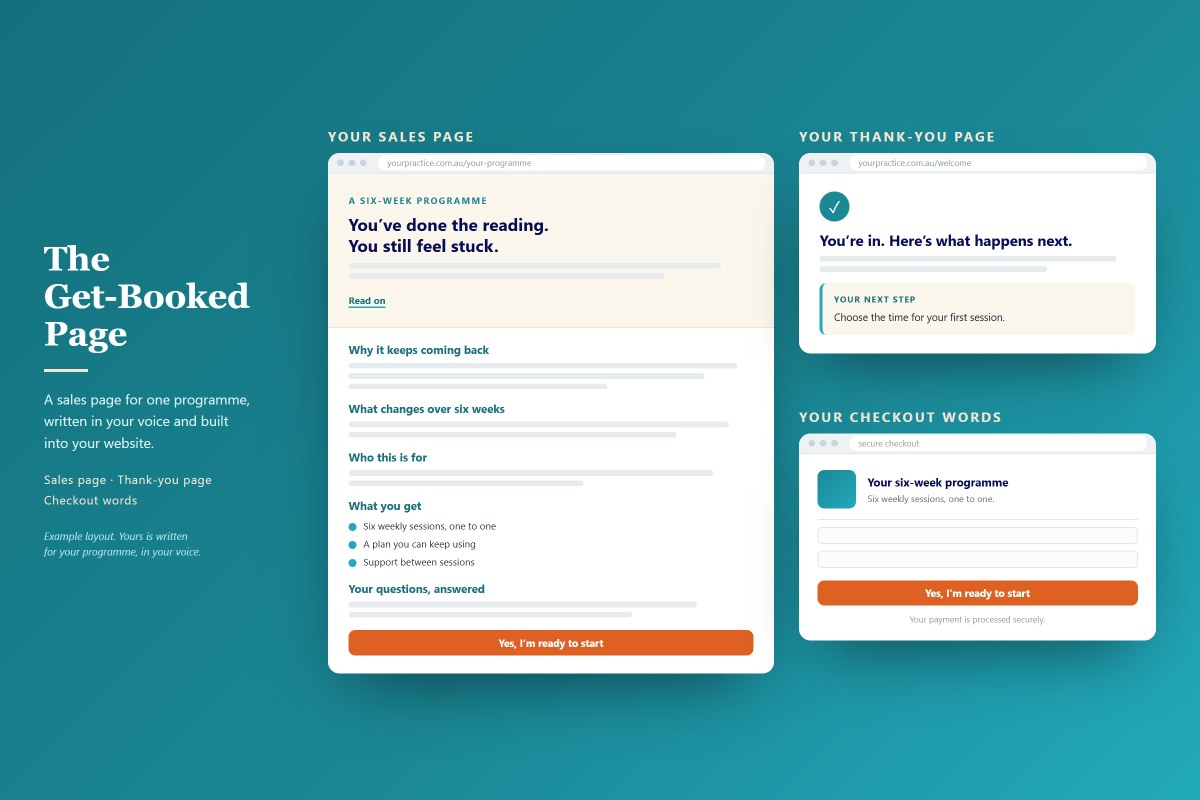
The Get-Booked Page is a done-for-you sales page for one of your programmes, written in your voice and built into your website. It starts with your reader’s problem, makes the case for your programme, and only then asks for the sale. In the right order, without hype, without pressure, and without sounding like anyone but you.
Everything happens by email, starting with a short form that asks exactly the right questions. You fill it in when it suits you, and I take it from there. If we ever need to talk something through, we can jump on a quick Zoom, but mostly the whole thing runs by email, which means your client hours stay yours.
What’s included
Why each piece matters
1
One long-form sales page for one programme, written in your voice
Long-form means it takes the room it needs to explain everything properly. It’s built from your answers, in your words. It starts with your reader’s problem, explains why what she’s tried hasn’t worked, shows how your programme is different, tells your story, answers her questions, and only then, once the case is made, shows the price and the button.
2
A thank-you page for after they pay
This is the page your buyer sees straight after paying. The moment someone becomes your client matters. This page tells them what happens next, so they feel good about their decision and you don’t have to chase anyone to explain the next step.
3
The checkout words
Your checkout is the payment page where someone enters their card details. The words on it should be short and clear. Someone who’s already decided doesn’t need to be sold to again. They need to be able to pay without second-guessing themselves.
4
The buy button opens the checkout on the page
When your reader clicks to buy, the payment page opens right there, over the page she’s reading. She never has to leave mid-thought to find a separate link, and the case for your programme stays intact right up to the moment she pays.
5
Built into your own website, set up for Google and AI search
The page is yours, on your site. It’s set up behind the scenes so Google, and the AI tools people now ask for recommendations, like ChatGPT, can read it and point people to it.
6
Six emails to bring warm readers to your new page
A new page sitting on your site won’t sell much on its own. People rarely book the first time they see something, so these six emails do the groundwork: three get your readers thinking about the problem your programme solves, then three invite them to the page. You load them into your own email system and send them as your page goes live.
7
Tracked, so you can see what’s working
The page counts how many people visit it and how many go on to buy, so you can see what’s working. No guessing.
8
Three rounds of changes within 30 days of going live
Going live means your page is published on your website, where anyone can see it. A round of changes is one list of things you’d like adjusted, which I make in one go. Read it on your own site. Show it to someone you trust. Sit with it for a few days. If something doesn’t sound like you, you’ve got three rounds to get it right.
9
Done by email and live within ten business days
You fill in a form that asks the right questions, and I work from that. You read your page on a private review link, we refine from there, and your page is live within ten business days of your form. The whole process runs by email, with a quick Zoom available if we ever need it.
How it works, step by step
You order. One payment, and you’re in. Your short form arrives straight away.
You fill in the form. It asks about your programme, your clients and the way you talk about your work.
My team and I write and build it. I bring the judgement: the structure, the argument, the sense of what sounds right for a practitioner who doesn’t want to feel salesy. My team takes care of the building.
You get a review link. It’s private, so you read your page before anyone else sees it, and tell me what to change.
Up to three rounds of changes within 30 days of going live. Each round is one list of changes from you, and I make them all.
It’s live. Your page is published on your website, where anyone can find it. Your programme has a page that makes the case for it, around the clock, without you having to be there.
Meet Carrie
Who’s behind this
Carrie Wallis
Author of From Strangers to Clients
I’m Carrie Wallis, author of the bestseller From Strangers to Clients. I teach counsellors, coaches, healers and consultants how to market their work without feeling like they’re selling themselves out.
I understand the particular discomfort of being brilliant at your work and deeply awkward about telling people why they should pay for it. I’ve spent a long time working out how to do that in a way that feels true to who you are. The Get-Booked Page is built on that.
Is this for you?
It’s for you if
You have at least one programme or package you’d love more people to buy, like a package of six counselling or coaching sessions, a group series, a course, or your signature work.
Right now it lives as a line on your services page (the page listing what you offer and what it costs), a card with a price, or something you explain on calls and hope for the best.
You’re a counsellor, coach, energy healer, consultant, or any practitioner who wins clients on trust.
You want a page that sounds like you, not like a marketer pretending to be you.
It’s probably not for you if
You don’t have a programme to sell yet. Get the programme clear first, then come back.
You want a whole new website. That’s the Get-Found Website. The Get-Booked Page is one page, for one programme, on a site you already have.
Questions people ask before they order
Will it sound like me?
That’s the whole point of the form. Its questions draw out the words you actually use when you talk about your work. And if something reads wrong in the draft, that’s what your three rounds of changes are for.
What counts as a programme?
Anything you sell as one thing with one price, from a package of six counselling sessions to a group series or a course.
I don’t have any testimonials for this programme yet. Is that a problem?
No. A good page earns trust by showing your reader you understand what she’s going through. If you do have kind words from past clients, and their permission to share them, I’ll use those.
What if I don’t have a website yet?
Start with the Get-Found Website, which builds you one. Your Get-Booked Page slots straight in after.
How much of my time will this take?
Most of it is the form, and the form only asks about things you already know by heart: who you help, what changes for them, and how your programme works. After that, you read the draft and tell me what to change. Everything runs by email, at a time that suits you, so there’s nothing to schedule around your client hours.
What about my payment system?
You keep using whatever you use now to take payment, such as Stripe, PayPal, Square or your booking software. I write the short words on your checkout (the payment page) and connect the buy button, so your reader can pay without being sent somewhere else. Your money goes straight to you, the same as it does now.
Can I have pages for more than one programme?
Yes. Each programme gets its own page, and two or three ordered together cost less. The prices are in the offer just below.
The offer
What you get...
One long-form sales page for one programme, written in your voice
A thank-you page with your buyer’s next step
The checkout words, short and clear
The buy button connected to your checkout, on the page
Six warm-up and invitation emails, written in your voice, ready for you to load and send
Built into your website, set up for Google and AI search
Tracking, so you can see how many people visit and how many buy
Three rounds of changes within 30 days of going live
Everything handled by email, so your client hours stay yours
Live within ten business days of your form
$797 AUD, one payment.
More than one programme?
Order two or three pages together and each extra page costs less.
Confident Prosperity Gold or Platinum member? Enter your member discount code at checkout for $300 off any of these.
One last thing
Every week your programme runs without a page like this, the people who might have said yes are meeting a price before they understand what they’re deciding. Some of them decide on the number. Some of them drift away. You don’t know who they were.
But here’s the thing… a page that makes the case properly, in your voice, is ten business days away.
If your programme is worth buying, and I’d wager it is, it’s worth having a page that says so.