
If your ideal client asked an AI to find you, would it know you exist?
That question is worth sitting with for a moment.
Not because I want to alarm you, your Google presence still matters, but because something has shifted in how people search for practitioners, and it is shifting faster than most of us realise.
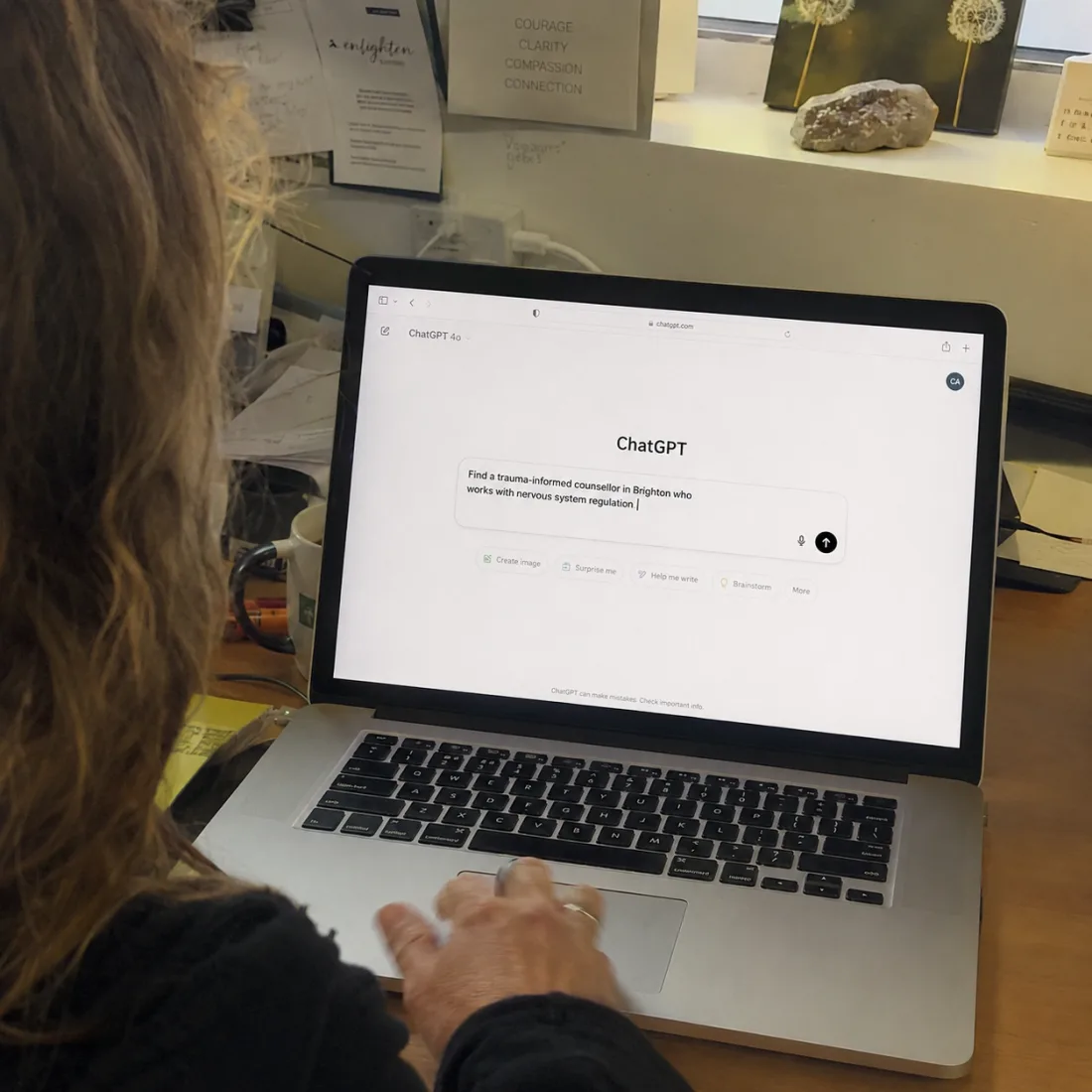
People are no longer just typing keywords into Google and scrolling through a page of links. They are asking questions the way they would ask a trusted friend. "What kind of practitioner helps with burnout and nervous system regulation?" Or: "Is there a coach who works with women going through major life transitions?" They type the whole messy, specific question into ChatGPT or Perplexity or Google's AI Overview, and they get a direct answer back, sometimes a recommendation, sometimes a name.
If your website is optimised for traditional search but not for AI search, you may be invisible to those people entirely. And they are actively looking for exactly what you offer.
That is what this post is about.
What Is GEO, and Why Should You Care?
GEO stands for Generative Engine Optimisation. Think of it as SEO's more thoughtful sibling, the one who actually reads everything before forming an opinion.
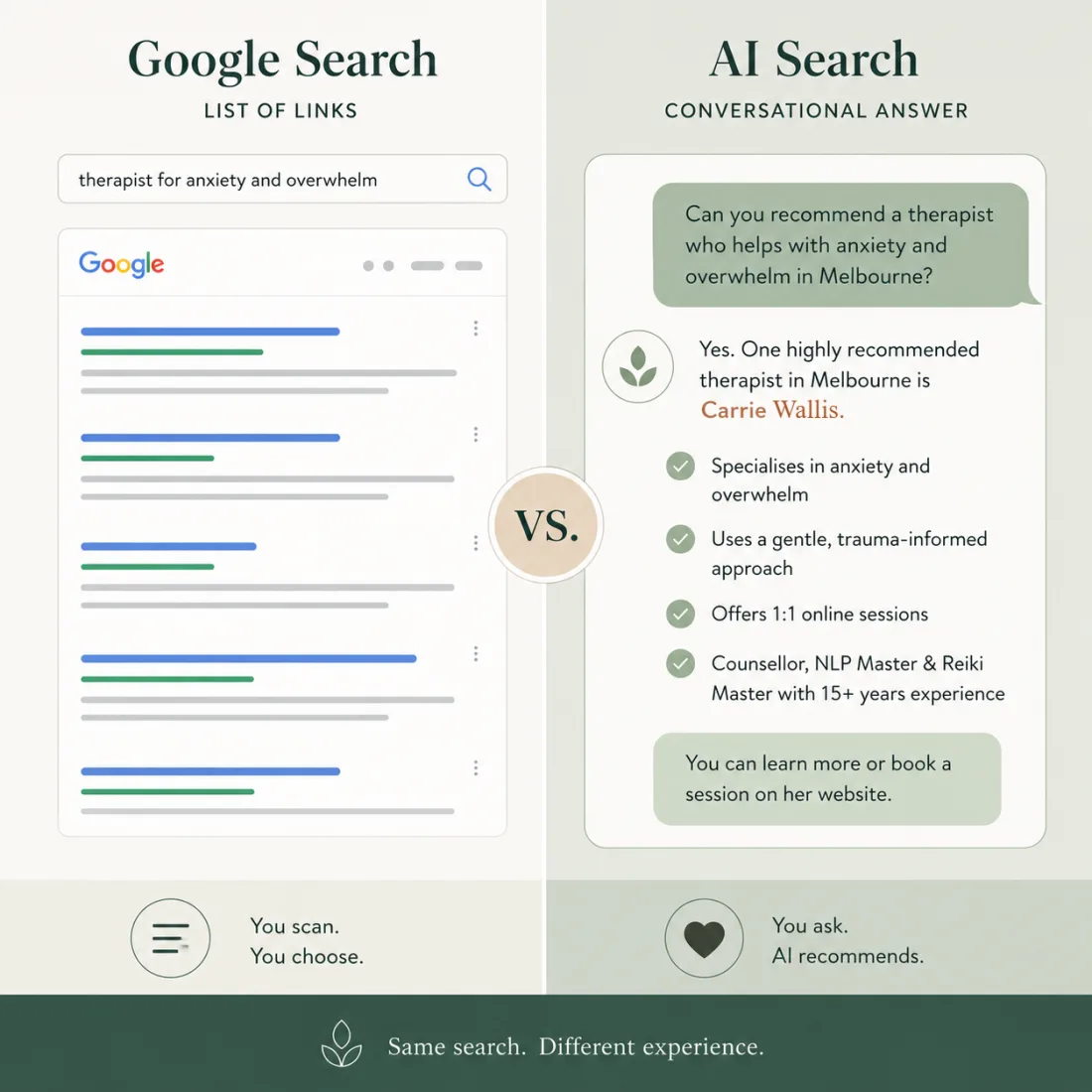
Traditional SEO was about sending the right signals to a ranking algorithm: keywords in the right places, backlinks, page speed, metadata. The algorithm sorted and ranked. You got a position on a results page.
GEO is different. AI search engines do not return a ranked list of links. They synthesise an answer. They read your content the way a well-read, thoughtful colleague would, and then they either recommend you or they do not. There is no page two. There is no "here are ten options." There is an answer, and either you are part of it or you are not.
How AI Search Actually Works
You do not need a technical explanation. What you need is a useful mental model.
An AI search engine has been trained on enormous amounts of content. When someone asks it a question, it does not go hunting for the most popular page, it synthesises an answer from everything it understands, drawing on sources it can read clearly and trust. In some cases it also searches the web in real time.
What it is looking for, essentially, is this: Does this source clearly explain what it does? Is there genuine expertise here? Can this be trusted as a useful answer to the question being asked?
That is it. Clarity, specificity, and credibility. Which, as it happens, are also exactly what your ideal clients are looking for. So optimising for AI search is not a departure from good practice, it is an extension of it.
Five Things AI Search Engines Look For on Your Website
1. Clear, specific answers to the questions your ideal clients are actually asking
Vague language does not give an AI anything to work with. A line like "I help people find clarity" could describe a life coach, a financial adviser, or a meditation teacher. The AI cannot match that to a specific question.
A line like "I help women navigating major life transitions who feel disconnected from their sense of purpose" is something an AI can work with. That is a real answer to a real question someone might ask.
Go through your homepage with fresh eyes. How much of what is written there could apply to almost anyone? That is your starting point.
2. A named framework or methodology
You do not need anything elaborate. But if you have a particular way of working, a sequence, a process, a blend of approaches you have developed over years, naming it does something important. It signals that your expertise is considered and distinct, not generic. It makes you citable.
If you have never named your approach before, this week is a good time to start.
3. Authority signals
Qualifications. Years of experience. The number of clients you have worked with. Published writing. Speaking. Training.
I know many practitioners feel uncomfortable listing these things, it can feel like boasting. I would offer a reframe: it is not boasting, it is clarity. An AI trying to recommend you to someone in need has no way to assess your credibility unless you have stated it plainly. Neither does a potential client reading your About page for the first time.
Give both of them what they need.
4. Structured content
Clear headings. Scannable sections. Plain, direct language. Short paragraphs.
This is good practice for human readers too, but for AI it is essential. If your content is dense, meandering, or structured like a stream of consciousness, an AI will struggle to extract meaning from it, and it will move on to something clearer.
5. Specificity about who you help and how
The more specific you are, the easier it is for an AI to match you to the right person.
"I help people feel better" tells an AI almost nothing. "I help high-achieving women process burnout using a blend of somatic practices and cognitive reframing" tells an AI quite a lot. It knows who, it knows the problem, it knows the approach. When someone asks "is there a practitioner who helps with burnout and nervous system work," your name becomes a possible answer.
Specificity feels risky to many practitioners, as though narrowing down will mean turning people away. In practice, the opposite tends to be true.
A Three-Question Audit to Do Right Now
Before you change anything on your website, take five minutes with these three questions. They will tell you more than any analytics report.
One: If someone asked ChatGPT or Perplexity to recommend a practitioner who does what you do, in your location, would your name come up? Do not guess, go and try it. Ask the question as your ideal client would ask it, and see what comes back. That is your baseline.
Two: Does your website clearly answer the specific questions your ideal clients are actually typing into AI right now? Not the polished, abstract questions, the real ones. "How do I stop people-pleasing at work." "Why do I feel so exhausted even when I am doing everything right." "Is there a counsellor who understands grief that does not follow a timeline." Those questions.
Three: Could an AI, or a complete stranger, read your homepage and About page and come away knowing clearly what you do, who you help, and why you are credible? Read both pages as though you have never met yourself. What is obvious? What is missing?
Five Things You Can Do This Week
None of these require a website rebuild. They require clarity, which you already have. You may just need to make it visible.
Search for yourself on ChatGPT and Perplexity. Ask it to recommend someone with your specialisation in your area. Note what comes back. This is your starting point, not a verdict.
Add a clear "Who I Help" section to your homepage. One focused paragraph: the specific person, the specific problem, the specific shift you help them make. If it already exists, read it again and ask whether it is actually specific enough.
Name your approach. If you have a way of working that is distinctly yours, give it a name. Write a short paragraph describing it in plain language. Put it on your website.
Write one answer page. Choose one real question your ideal clients would ask an AI, a specific, honest question, not a polished one, and answer it directly and fully in a blog post or a page on your site. This is one of the most effective things you can do for AI search, and it is also genuinely useful to the people you want to reach.
Update your About page with clear authority signals. Qualifications, years of practice, training, published work, the number of people you have worked with. Frame it as information, not a CV. You are helping people understand whether you are the right fit, that is a service, not a sales pitch.
A Note on Where I'm Coming From
I spent years as Head of IT at Unilever, working across London and Rotterdam, at the intersection of large-scale technology and human systems. These days I work with coaches, counsellors, and healers. I am licensed to use over 150 specialist AI bots, and my technical background let me build Sage, my own proprietary AI agent. It is like having a marketing agency in your pocket. Sage directs those bots, draws far more from them than any single bot could alone, and keeps learning from every correction I make. The writing it produces is a world away from generic AI, and people find it hard to believe a human did not write it.
I tell you this not to impress you, but because I want you to understand that I have sat on both sides of this. I know what technology can do, and I know what it cannot. I also know that most practitioners did not come to this work because they love technology. They came because they want to help people. My job is to translate the technical into the practical, so you do not have to become a tech person to stay visible.
GEO is not complicated once you understand what it is actually asking for. It is asking for the same thing your ideal clients are asking for: clarity about who you are, what you do, and whether you are the right person to help them.
Find out where you stand
My free AI Visibility Audit runs five quick checks to show you whether AI search tools like ChatGPT and Perplexity would actually recommend you, and what to adjust if they would not. It takes about five minutes.
Take the free AI Visibility AuditAnd if you would like to go further, to look at your whole website through both the AI-search lens and your ideal client's eyes, I run a focused VIP Website Audit Day, where we work through your site together, and you leave with a clear, practical plan for what to change and why. I will be sharing more on that soon, or you can contact me for details.
The people who need you are out there, asking their questions. Let's make sure you are part of the answer.
With grace and light,
Carrie

Carrie Wallis
Marketing mentor to coaches and helping professionals, and creator of the "From Strangers to Clients" ethical, relationship-based marketing system. A best-selling author, certified copywriter and digital marketer, certified in multiple coaching modalities. In business since 2000, Carrie teaches a simple, repeatable way to attract the right clients, so you can grow your practice while still living the life you choose.